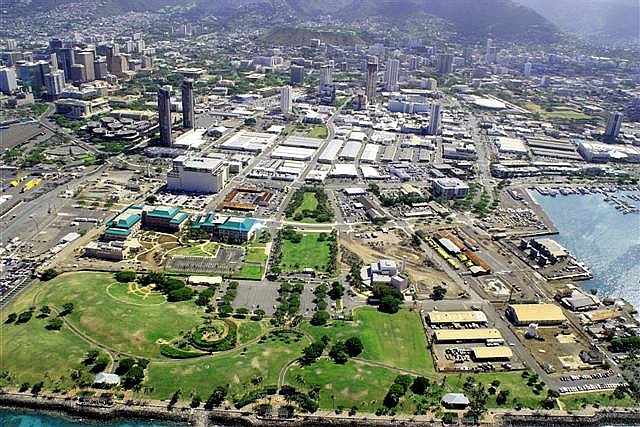
Once again, we are confronted with the question of whether to fully fund Oahu’s rail project. I can't help but draw comparisons with recent world events, like Brexit.
Whether one agrees with the outcome of the UK vote to leave the European Union (52% to 48%), a lesson can be learned about making decisions based on passions and populism. Many UK voters are only now considering the gravity of their vote. Some are even asking their government for a “do over,” because their vote was a “protest vote.” They didn’t mean it.
We aren't holding a referendum on rail, but the "in or out" question is just the same. Should we fully fund the Oahu’s rail project, from start to finish, all 20-miles, 21-stations (and at some point in the near future, extensions to UH Manoa, West Kapolei, and Waikiki)? This sounds like a simple question; however, like the question before UK voters, it's far more complicated. When considering the ultimate question on rail, one should consider the purpose of the project, why Oahu needs it, and whether it will resolve the issue Oahu is trying to address in the least impactful way.
The construction and completion of Honolulu’s rail system as planned will have far reaching economic, social, and environmental impacts and benefits. The overarching purpose of the project is to provide high-capacity rapid transit in the highly congested east-west transportation corridor between Kapolei and UH Mānoa. The project is needed to improve mobility for travelers who face increasingly severe traffic congestion, improve transportation system reliability, provide accessibility to new development in support of adopted City land use plans, and improve transportation equity.
Rail will serve nearly 70 percent of Oahu's population and more than 80 percent of working taxpayers. With the opportunity to create new communities and rejuvenate existing communities along the alignment, comes endless possibilities to ensure that housing options go vertical and not sprawl out horizontally, preserve the Island’s limited space, implement walkable communities, and reduce the cost of transportation for Hawaii’s families. These are the kinds of communities that surveys show both millennials and our aging population want to live in, work in, and retire in.
Project ridership in 2030 is expected to be about 119,600 weekday passenger trips. Rail will eliminate an estimated 40,000 car trips from our congested streets and highways. Each four-car train can carry more than 800 passengers, the equivalent of more than ten buses. Because it operates on its own elevated fixed rail, it will take just 12 minutes to get from the airport to the downtown station.
Is the fixed, elevated guideway and technology the best option? The debate continues. All we can do in a civilized democracy is establish a good process. The rail decision process began before 2005 and included elected officials, experts, and the public. Many options were considered and the majority ruled. Subsequent judicial challenges of the environmental review process resulted in an outcome that ensured the avoidance, minimization, or mitigation of significant environmental impacts.
After more than a decade of planning, debate, technical reports, litigation, false starts, and finally construction, we find ourselves with a set of trains, several miles of guideway, and a nearly complete operations center. Is it time to stop or only build a part of the project? I hope not. Honolulu's rail project is the democratically arrived at best option to address our quality of life.
As we consider what we do next, all factors must be taken into consideration. As we learned from our friends in the UK, there are no do overs.
Exploring the Intersection of Land Use Law, Policy, and Practice in Hawaii
Showing posts with label Planning. Show all posts
Monday, June 27, 2016
Thursday, August 27, 2015
Ensuring Small Businesses Thrive During Rail Construction
A report by PolicyLink (a national research and action institute advancing economic and social equity), outlines successful strategies that have been used to help businesses survive and thrive in Seattle, Washington, and St. Paul, Minnesota.
Best practices identified in the report, include:
- The right type of financial assistance must be available to meet business’s needs.
- Outreach to businesses should begin well in advance of construction.
- Business technical assistance is vital.
- Communication is Key - Projects can have unpredictable timelines.
- Strong advocacy and organizing by multiple partners (e.g., foundations, non-profits, government, private sector, universities, etc.).
- In both Seattle and St. Paul, the cities played an important leadership role.
![]() |
| Seattle, Washington |
In Seattle, a $50 million Community Development Fund ("CFD") was created. The CFD was largely funded by the City of Seattle, which contributed $35 million of Community Development Block Grant ("CDBG") funding over seven years and $7.8 million from the City's general fund. Qualified small businesses could apply for CFD funds for such things as relocation costs; business interruptions payments; and low-interest loans for advances related to operations, equipment, and tenant improvements.
After construction of the affected rail line in 2009, the retention rate was 85 percent for all businesses, and 90 percent for businesses that had received assistance.
![]() |
| St. Paul, Minnesota |
The City of St. Paul created a $4 million Ready for Rail Business Support Fund through a Joint Powers Agreement between the Met Council and the Housing and Redevelopment Authority of the City of St. Paul. The loan fund was originally seeded with a small grant by the Central Corridor Funders’ Collaborative, The Met Council, and the City of St. Paul. The fund is administered by two local nonprofits.
In addition to the loan program, 40 business and community leaders came together to form the Business Resources Collaborative ("BRP") to support small businesses through the construction process. In partnership with community development organizations, they hired “small business consultants” to do extensive outreach to the businesses along the corridor. Assistance provided, to about 95 percent of qualifying businesses, included support with accounting, taxes, and marketing. About $1.2 million was spent on direct technical assistance primarily funded by the Central Corridor Funders’ Collaborative, St. Paul Foundation, and Bigelow Foundation.
Due in large part to the work of BRP and its collaborators, of the 1,144 businesses located along the corridor, 84 closed or relocated, and 84 new businesses opened. Nearly two-thirds of businesses expected their sales would increase, post construction.
For more, read the full report, Business Impact Mitigations for Transit Projects, PolicyLink, November 2013.
Tuesday, August 11, 2015
Land Use and Planning Law Can be Beautiful--Literally
A word cloud is an image composed of words used in a particular text, in which the size of each word indicates its frequency. The word clouds below show the 50 most frequently used words in selected sections of the City and County of Honolulu's ordinances related to land use.
![]() |
| TOD Special Districts ROH Sections 21-9.100 through 21-9.100-4 |
![]() |
| Interim planned development – Transit (IPD-T) Projects ROH Section 21-9.100-5 |
Wednesday, May 20, 2015
Would You Use Public Transit if You Could Save between $20,000 and $80,000 on Your Home?
The cost to build a parking stall can range anywhere from $20,000 to $80,000 or more.
Progressive communities like the City of Seattle, San Francisco Bay Area, and Washington DC are looking beyond parking stalls and pursuing strategies toward promoting transportation, parking, and personal mobility efficiencies. For example, the City of Seattle does not require parking for new buildings located in downtown or transit-friendly areas, and it continues to investigate policies that allow it to grow and evolve in ways that are functional, economic, and livable.
In a recent report prepared for the Seattle City Council, the City's planning department and state DOT analyzed the City’s vehicle and bicycle parking requirements for residential uses. Their approach placed a preference on "lower costs to build housing rather than the storage of automobiles."
The report identified the following findings and best practices:
- Take steps to aid housing affordability by limiting the financial impacts of parking on housing
- Avoid requiring excess parking
- Manage on‐street parking to reduce demand
- Requirements for off‐street parking artificially support driving
- Requiring more off‐street parking does not directly lead to less on‐street parking demand
- Increasing access to and knowledge about transportation helps people choose from a variety of convenient and affordable options
- Housing and transportation costs are the greatest burdens on household budgets
- Equitable approaches that provide transportation options make a real difference for those who most need those choices
- Use a combination of strategies
![]() |
| Puget Sound Bike Share |
Recommendations included:
- Tailor parking requirements for new development in areas with frequent transit service
- Require a “residential transportation options program” that includes requirements for multifamily building owners to provide transit passes and other mobility options for residents of new buildings (actual costs of this type of program will be a small fraction of the cost of building new parking)
- Adopt a map showing where parking is not required, providing more predictability for permit applicants, neighbors, and planning department staff
- Remove code barriers to shared parking options, and address garage design to facilitate shared use parking; Consider code revisions to allow bike share and car share in‐lieu of required parking
- Update bicycle parking code requirements to better address secure, comfortable, long‐term bicycle parking needs
The full report, "City of Seattle Parking Review: Report to Council PLUS Committee," April 13, 2015, is available at http://www.seattle.gov/dpd/cityplanning/2015parkingreport.pdf.
Monday, December 8, 2014
Transit-Oriented Development Resources
As signs of the Honolulu Rail Transit Project appear on Oahu's landscape, TOD and Honolulu Rail are sure to be topics of discussion in 2015 and beyond.
Here are some resources for your reading pleasure:
![]() |
| Rail columns in West Oahu work their way East. |
- Smart Growth Ideas will Help Guide Transit-Oriented Development. Editorial by by Jesse Souki, Director, Office of Planning, Jan. 28, 2013.
- Hot Topics: Transit Oriented Development. Presentation by Jesse Souki, Director, Office of Planning, April 17, 2013.
- Ten Principles for Successful Development Around Transit. The Urban Land Institute (ULI) prepared this report, which explores the question: What does it take to make TOD work? The principles presented are targeted toward communities, designers, and developers.
- Leveraging State Agency Involvement in Transit-Oriented Development to Strengthen Hawaii’s Economy. In 2012, the Office of Planning with the assistance of Smart Growth America prepared this report. The report recommends ways that Hawaii state agencies can leverage TOD to maximize benefits to the State of Hawaii and, by extension, the people of Hawaii. The recommendations were developed through a series of meetings with representatives from over 40 organizations, including government, private sector, and nonprofit organizations.
- State Owned Parcels Near Rail Stations. An interactive GIS tool prepared by the State GIS Program.
- City and County of Honolulu's TOD Web Site. The City is leading the way with TOD planning and creating a space for communities, businesses, and landowners to conceive of a future with rail.
- Transit-Oriented Development USDOT Web Site. USDOT, Federal Transit Administration, provides definitions and resources at this Web site.
- State Office of Planning TOD Web Site. This Web site includes various resources related to the state's involvement in TOD.
- Infrastructure Financing Options for Transit-Oriented Development. This report provides communities with a comprehensive guide of tools and strategies that are available for financing and funding for TOD infrastructure. It provides examples of how some communities are using specific tools for individual infrastructure components, as well as strategies for combining and bundling tools to create plans that address construction phasing and market growth over time.
- Leveraging transit-oriented development for economic growth, better living in Hawaii. Discussion by Smart Growth America on TOD potential in Hawaii posted on December 28, 2012.
- Report on the State of Physical Infrastructure in Hawaii: Phase II. This study, prepared by the Hawaii Institute for Public Affairs with support from the US Economic Development Administration, summarizes the statewide economic impacts of significant long-term infrastructure projects over the next 20 years based on location of the projects, including direct and indirect employment, total household revenues (income) generated, tax revenues generated, and total revenues generated into the economy.
Thursday, October 17, 2013
Top 10 Tips for Getting Through the Land Use Regulatory Process
- Local knowledge - Nothing grabs a community's attention like a construction project in or around their neighborhood. Be it public utility, roads, schools, houses, or commercial project, people want to know what you're doing, why you're doing it, and how it will affect them. Reaching out to the community early, often, and in a way that values their input is not only being a good neighbor, but often a regulatory prerequisite. Outreach needs to be strategic. It's not enough to have large public meetings. Gathering public input also means meeting with the right people, such as community leaders (not necessarily elected) who represent broader communities. Having a good public outreach plan that is prepared in consultation with folks who know the community, coordinated with project planning, can help focus efforts and avoid regulatory duplication.
- Identify key regulatory personnel - So you stopped by X agency and you talked to someone, and you walked away feeling pretty good because that person said that your project should get through the regulatory process without any problems. Don't start counting your chickens until you ask yourself these questions: (1) Are you pursuing the correct regulatory approval, (2) Are you at the correct agency, and (3) Does the person you spoke to have authority to speak for the agency? Your answers should be: yes, yes, and yes.
- Complete the application - Applicants file incomplete applications all the time. In the best of circumstances, the applicant failed to get professional help and doesn't understand the process. In the worst case, the applicant expects the regulator to do the applicant's work by reviewing the incomplete application and telling the applicant how to complete it. In the former case, agencies generally have guidance available than can help the public navigate the permitting process. However, in the latter case, it's just unprofessional. It's a sure way to upset a regulator--and you don't want that. Most regulators want to help you get through their process quickly and efficiently. They don't want a backlog. If you have a critique about a certain requirement, a regulator can't change that. You'll need to take it up with the legislative body that makes law. Also, there is a difference between turning in an incomplete application and pre-consultation. Pre-consultation, before submitting an application and after the applicant has done some research, is encouraged.
- Don’t skimp on planning and outreach - Old Ben Franklin's adage should be taken to heart: An ounce of prevention is worth a pound of cure. Early planning, which includes a permitting, entitlement, environmental review, and outreach strategy at the front end of a project significantly reduces financial and legal risk during final design and construction. A frustrated developer once told me, "It doesn't matter what we do, we'll be sued anyway." Well yes, that may be true, but thoughtful planning can reduce the amount of time you spend in court and reduce the likelihood of a court telling you that the project needs to start over.
- Know the game: discretionary or ministerial - Knowing this will inform how you develop your project development strategy. Ministerial or over-the-counter permits are those that have very specific code requirements that must be fulfilled before it is approved, like a building permit. A discretionary approval allows the regulator more discretion for tailoring an approval with various requirements of approval based on broader criteria, like a change of zoning request. This usually involves a board, commission, or elected body
- Define your project—stick to it - Granted, as you work through planning, permitting, and environmental review, elements of the project may change; however, you should go into the process with a clear understanding of the proposal's purpose and need. This should be clear and concise, because changing the purpose and need midstream while working through the panoply of land use approvals can have unintended consequences. If the project is changed too much, you may need to start over.
- Follow approval criteria - You do not need to win a regulator over on how great your project is. All the regulator needs to know is how your proposal satisfies the regulatory criteria and process required by the particular permit or entitlement you are applying for. Write clearly and concisely. Show exactly how the facts of your proposal match up with regulatory requirements. Enable the regulator to expeditiously process your application.
- Look for opportunities for concurrency - The permitting, planning, and environmental review processes allow many opportunities for cross-referencing reports, facts, figures, and public hearings. For example, environmental review documents can be used to concurrently address permitting requirements; and county, state, and/or federal requirements often share similar requirements and criteria.
- Have the right team of experts - Depending on the complexity of your proposal and whether it's a ministerial or discretionary approval, you will need several experts, for example, architects, engineers, planners, lawyers, and financial experts. Although many of these fields are cross-trained to some extent, it's rarely a good idea to substitute one for the other. You can't build a house with only a hammer--you need the whole toolbox.
- Be sure your team is communicating - It is not uncommon for well-intended team members to not adequately communicate with the rest of the development team. The attorney can't reduce legal risk if he doesn't know what the planners are recommending for their environmental impact statement strategy. The planners can't properly address potential alternatives if the engineers have one approach in mind for design that no one knows about. Someone needs to be able to organize the team so the proper disciplines are working on the right issues, and communication across disciplines is happening to ensure that all decisions are fully informed and aimed at achieving the project purpose and need.
I originally presented this list at a workshop on green industry permitting. Materials for the workshop will be posted at http://planning.hawaii.gov/navigating-the-permit-process-tips-tools-for-green-industry/.
Thursday, January 17, 2013
Don’t Be Afraid of the Alphabet Soup: TODs and PPPs
This entry was submitted to and published by the Star-Advertiser on January 28, 2013, under the title, "Smart Growth ideas will help guide transit-oriented development," at http://www.staradvertiser.com/editorialspremium/20130128_Smart_Growth_ideas_will_help_guide_transitoriented_development.html.
In partnership with Smart Growth America, the State Office of Planning prepared a report entitled, Leveraging State Agency Involvement in Transit-Oriented Development to Strengthen Hawaii’s Economy, which is available online at http://goo.gl/tNEFQ.
We brought together various public (city and state), private, and community stakeholder representatives to discuss ways that state agencies can leverage transit-oriented development (TOD) to maximize benefits. Whatever you think about the Honolulu rail project, the fact of the matter is that there is a significant amount of state owned land within a 1/2 mile walking distance of the proposed transit stations. What does a future with rail and state properties around it look like? We asked state agencies to consider their roles as major property owner, largest state employer, and service provider. The recommendations in the report are based on those inter-agency discussions.
The report encourages using a Smart Growth approach, because of its many community and environmental benefits. These principles are supported, for example, by the U.S. Environmental Protection Agency (EPA), Department of Transportation, and the Department of Housing and Urban Development. In the report, we matched Smart Growth principles with TOD elements and New Day priorities to help guide better decision making. For example, one principle is to create a range of housing opportunities and choices. This aligns with the TOD element to “incorporate a range of housing and employment building types based on local character and the transit station area's role within the transit network market area,” which in turn supports the New Day agenda item “ensuring access to affordable housing and human services.” There are several of these connections we make on page 6 of the report, which reduces our dependence on fossil fuels, creates healthier communities, and preserves and protects open space and agricultural lands.
Nowhere in our report do we recommend planning, permitting, or environmental exemptions of any kind, as incorrectly suggested by commentators in the Star-Advertiser. TOD is simply a method for developing communities in a way that maximizes the use of public transit. In the context of TOD, there also seems to be a misunderstanding about what public private partnerships (PPP) are. PPPs are merely one method for delivering public projects that allows a public entity to share in the risks and rewards of public projects with the private sector. PPPs have been used in other states for housing projects, waterfront projects, airport improvements, and all variety of public projects. It would be a mistake to write-off PPPs. In the December 2012 publication of Governing, experts predict an increase in the use of PPPs by state and local governments as they become more strapped for cash.
The report is not the end of the discussion. And no matter what tool is used to deliver public projects, successful public projects depend on community and stakeholder collaboration in development decisions (another Smart Growth principle). The ten basic Smart Growth principles is a good starting place for delivering public projects and are discussed on EPA’s Web page at http://www.epa.gov/dced/about_sg.htm.
Jesse K. Souki, Esq.
Director, State Office of Planning
In partnership with Smart Growth America, the State Office of Planning prepared a report entitled, Leveraging State Agency Involvement in Transit-Oriented Development to Strengthen Hawaii’s Economy, which is available online at http://goo.gl/tNEFQ.
We brought together various public (city and state), private, and community stakeholder representatives to discuss ways that state agencies can leverage transit-oriented development (TOD) to maximize benefits. Whatever you think about the Honolulu rail project, the fact of the matter is that there is a significant amount of state owned land within a 1/2 mile walking distance of the proposed transit stations. What does a future with rail and state properties around it look like? We asked state agencies to consider their roles as major property owner, largest state employer, and service provider. The recommendations in the report are based on those inter-agency discussions.
The report encourages using a Smart Growth approach, because of its many community and environmental benefits. These principles are supported, for example, by the U.S. Environmental Protection Agency (EPA), Department of Transportation, and the Department of Housing and Urban Development. In the report, we matched Smart Growth principles with TOD elements and New Day priorities to help guide better decision making. For example, one principle is to create a range of housing opportunities and choices. This aligns with the TOD element to “incorporate a range of housing and employment building types based on local character and the transit station area's role within the transit network market area,” which in turn supports the New Day agenda item “ensuring access to affordable housing and human services.” There are several of these connections we make on page 6 of the report, which reduces our dependence on fossil fuels, creates healthier communities, and preserves and protects open space and agricultural lands.
Nowhere in our report do we recommend planning, permitting, or environmental exemptions of any kind, as incorrectly suggested by commentators in the Star-Advertiser. TOD is simply a method for developing communities in a way that maximizes the use of public transit. In the context of TOD, there also seems to be a misunderstanding about what public private partnerships (PPP) are. PPPs are merely one method for delivering public projects that allows a public entity to share in the risks and rewards of public projects with the private sector. PPPs have been used in other states for housing projects, waterfront projects, airport improvements, and all variety of public projects. It would be a mistake to write-off PPPs. In the December 2012 publication of Governing, experts predict an increase in the use of PPPs by state and local governments as they become more strapped for cash.
The report is not the end of the discussion. And no matter what tool is used to deliver public projects, successful public projects depend on community and stakeholder collaboration in development decisions (another Smart Growth principle). The ten basic Smart Growth principles is a good starting place for delivering public projects and are discussed on EPA’s Web page at http://www.epa.gov/dced/about_sg.htm.
Jesse K. Souki, Esq.
Director, State Office of Planning
Saturday, September 22, 2012
What Kind of Community Will Baby Boomers Want to Live In?
According to Hawaii Business Magazine, "[t]he first wave of baby boomers—approximately 80 million Americans who were born between 1946 and 1964—is turning 65 in 2011." "Hawaii has the fastest growing age 65-plus population in the nation, expected to grow by 81 percent by 2030."
The World Health Organization (WHO) consulted with 35 cities from all continents (including, New York and Portland in North America). Their work culminated in a 2007 report entitled, Global age-friendly cities: a guide.
Here is an excerpt from the Report entitled, Age-friendly outdoor spaces and buildings checklist:
The World Health Organization (WHO) consulted with 35 cities from all continents (including, New York and Portland in North America). Their work culminated in a 2007 report entitled, Global age-friendly cities: a guide.
Here is an excerpt from the Report entitled, Age-friendly outdoor spaces and buildings checklist:
Environment
Green spaces and walkways
- The city is clean, with enforced regulations limiting noise levels and unpleasant or harmful odors in public places.
- There are well-maintained and safe green spaces, with adequate shelter, toilet facilities and seating that can be easily accessed.
Outdoor seating
- Pedestrian-friendly walkways are free from obstructions, have a smooth surface, have public toilets and can be easily accessed.
- Outdoor seating is available, particularly in parks, transport stops and public spaces, and spaced at regular intervals; the seating is well-maintained and patrolled to ensure safe access by all.
Pavements
The above list appears to be consistent with good planning principles such as the City and County of Honolulu's Complete Streets Ordinance, transit-oriented development (TOD), and EPA's Smart Growth Principles.Roads
- Pavements are well-maintained, smooth, level, non-slip and wide enough to accommodate wheelchairs with low curbs that taper off to the road.
- Pavements are clear of any obstructions (e.g. street vendors, parked cars, trees, dog droppings, snow) and pedestrians have priority of use.
Traffic
- Roads have adequate non-slip, regularly spaced pedestrian crossings ensuring that it is safe for pedestrians to cross the road.
- Roads have well-designed and appropriately placed physical structures, such as traffic islands, overpasses or underpasses, to assist pedestrians to cross busy roads.
- Pedestrian crossing lights allow sufficient time for older people to cross the road and have visual and audio signals.
Cycle paths
- There is strict enforcement of traffic rules and regulations, with drivers giving way to pedestrians.
Safety
- There are separate cycle paths for cyclists.
Services
- Public safety in all open spaces and buildings is a priority and is promoted by, for example, measures to reduce the risk from natural disasters, good street lighting, police patrols, enforcement of by-laws, and support for community and personal safety initiatives.
Buildings
- Services are clustered, located in close proximity to where older people live and can be easily accessed (e.g. are located on the ground floor of buildings).
- There are special customer service arrangements for older people, such as separate queues or service counters for older people.
Public toilets
- Buildings are accessible and have the following features: elevators, ramps, adequate signage, railings on stairs, stairs that are not too high or steep, non-slip flooring, rest areas with comfortable chairs, and sufficient numbers of public toilets.
- Public toilets are clean, well-maintained, easily accessible for people with varying abilities, well-signed and placed in convenient locations.
Tuesday, September 18, 2012
Act 55 (2011), Hawaii's Public Land Development Corporation (PLDC)
| Source: Wikipedia |
The PLDC is the newly created "development arm of the department of land and natural resources (DLNR)." According to DLNR's Web site, its mission statement is as follows: "Enhance, protect, conserve and manage Hawaii’s unique and limited natural, cultural and historic resources held in public trust for current and future generations of visitors and the people of Hawaii nei in partnership with others from the public and private sectors." A portion of the monies earned from PLDC activities are deposited into the Hawaii public land development revolving fund, which ostensibly helps DLNR achieve its mission.
The PLDC is authorized to "identify the public lands that are suitable for development . . carry on marketing analysis to determine the best revenue-generating programs for the public lands identified, enter into public-private agreements to appropriately develop the public lands identified, and provide the leadership for the development, financing, improvement, or enhancement of the selected development opportunities." In particular, Act 55 enumerates the following non-exhaustive list of "[p]ermissible uses . . . office space; vehicular parking; commercial uses; hotel, residential, and timeshare uses; fueling facilities; storage and repair facilities; and seawater air conditioning plants."
There are five board of directors: chairperson of the board of land and natural resources; director of finance; director of business, economic development, and tourism; and one member each appointed by the speaker of the house of representatives and the president of the senate. The board appoints an executive director who may appoint officers, agents, and employees.
Various powers to develop public land are granted to the PLDC, such as the ability to make and execute contracts and sue and be sued. The PLDC has several financing mechanisms at its disposal, including the power to issue revenue bonds (with the approval of the governor). It can "[o]wn, hold, improve, and rehabilitate any real, personal, or mixed property acquired; and sell, assign, exchange, transfer, convey, lease, or otherwise dispose of, or encumber the same[.]" PLDC can partner with "qualified persons or other governmental agencies[.]"
The PLDC must "prepare the Hawaii public land optimization plan, which shall define and establish goals, objectives, policies, and priority guidelines for its public land optimization development strategy." Act 55 provides that the plan must include the following five elements: inventory of public lands, protection of culturally-sensitive areas, feasible strategies for the promotion and marketing of any projects, information on market demands and trends, and strategies for federal and state legislative actions.
The PLDC must coordinate with county governments and private landowners. "[P]ublic land planning activities of the corporation shall be coordinated with the county planning departments and the county land use plans, policies, and ordinances." "Any undertaking by the corporation . . . shall be with the express written consent of the landowner or landowners directly affected."
Projects developed by the PLDC are "exempt from all statutes, ordinances, charter provisions, and rules of any government agency relating to special improvement district assessments or requirements; land use, zoning, and construction standards for subdivisions, development, and improvement of land; and the construction, improvement, and sale of homes thereon; provided that the public land planning activities of the corporation shall be coordinated with the county planning departments and the county land use plans, policies, and ordinances."
With regard to hotel projects, Act 55 applies HRS §171-42, which provides as follows "[w]here public land disposed of for hotel or resort use is adjacent to any beach, waterway, or historic monument or landmark, the disposition shall be subject to reservations of public right-of-way or public access at all times to such beach, waterway, historic monument, or landmark." Under HRS §171-42, in certain circumstances the PLDC can sell the fee for state land "with the prior approval of the governor, and subject to disapproval by the legislature by two-thirds vote of either the senate or the house of representatives or by majority vote of both[.]"
The terms and provisions of Act 55 will be further defined through rule-making. To learn more about PLDC's rule-making process, visit http://hawaii.gov/dlnr/pldc.
Sunday, January 29, 2012
Saturday, October 29, 2011
TOD, TAD, TAJ: Transit Development Alphabet Soup
You may have heard of transit-oriented development (TOD) in conversations about Honolulu's 20-mile, 21-station rail transit project. But, you may not have heard of TADs and TAJs.
The Transit Cooperative Research Program's August 2011 Legal Research Digest defines these terms and more in its recent report entitled, Transit-Oriented and Joint Development: Case Studies and Legal Issues.
- Transit-Oriented Development (TOD). TOD sets the framework for good transit-oriented planning and development. The Report identified a performance based definition of TOD: "A TOD typology should meet five main goals: location efficiency, rich mix of residential and commercial choices, value capture, place making, and the resolution of the tension between node and place." The demand for TOD is expected to increase based on three trends "a resurgence of downtowns, continued growth of the suburbs, and a renewed interest and investment in transit."
- Transit-Adjacent Development (TAD). A TAD is not good. "A TAD is just that—development that is physically near transit; it fails to capitalize upon this proximity, however, to promote transit riding. A TAD lacks any functional connectivity to transit—whether in terms of land-use composition, means of station access, or site design. A number of U.S. TODs discussed in the literature more closely resemble TADs." The Report goes on to describe TAD's as "more suburban-like, with lower densities, a dominance of surface parking and auto-centric design, limited pedestrian and bicycle access, more single-family homes, and industrial and segregated land uses."
- Transit-Joint Development (TJD). TJD is good in the context of transit. According to the Report, "joint development, in the context of TOD, is the process in which a public entity and a private developer work together under a common vision in order to create a successful development." Joint development projects can be classified into nine sub-categories based on two broad categories: revenue-sharing and cost-sharing arrangements. The nine sub-categories are "1) station leases and development, 2) nonstation leases and development, 3) station interface or station connections, 4) benefit assessment district, 5) incentive agreements, 6) cost-sharing agreements, 7) joint use of facilities, 8) capital or service provision, and 9) development-concession leases." The Report found that "four conditions are necessary for TJD: a healthy local real estate market, an entrepreneurial public agency, coordination across agencies, and the recognition that the benefits of TOD extend beyond generating revenues."
The Report surveys the statutory and regulatory frameworks for TOD. It found that "the programs fall into three basic types: those that either encourage or require planning or zoning for TOD and joint development, those that provide funding for TOD-related infrastructure or housing, and those that provide basic legal authority to transit agencies to engage in TOD/joint development activities." The Report also expores market demand, case law, and case studies.
The Report concludes that "TOD/TJD, successful projects do not happen on their own, or just because government has invested public money into transit and other infrastructure. TOD and joint development projects succeed, most fundamentally, because there is a market for those types of development." In addition to supportive market conditions, "structures of both public and private law" are crucial for success. Suggested laws and programs include:
- Transit agency authority to engage in TOD and joint development.
- Direction to local government to plan and regulate for TOD and joint development.
- Federal involvement in TOD and joint development.
- TOD and joint development as part of local and regional visioning processes.
- TOD planning and incentive grant programs.
- Infrastructure investment programs that support or prioritize TOD.
- Infrastructure concurrency or adequate public facilities requirements.
- Funding programs that cover construction costs or provide incentives for the location of housing and other development in TOD areas.
The Report can be downloaded at http://onlinepubs.trb.org/onlinepubs/tcrp/tcrp_lrd_36.pdf.
To read more about transportation issues, visit Transportation.
Sunday, October 9, 2011
Climate Change Policy's Other Half: Adaptation
Pundits may disagree on the extent and scope of climate change, but the global climate is changing. See Joint science academies’ statement: Global response to climate change, available at http://www.nationalacademies.org/onpi/06072005.pdf.
Impacts will include sea level rise and more impactful but less frequent storm events, among other things. Adaptive planning today, will determine how resilient future communities will be to these impacts--particularly for costal communities like Hawaii.
Climate change adaptation planning is a crucial policy component for addressing climate change that is frequently overlooked by public and private decision-makers. For even if the US were to switch to "using sources that emit no particulates, like nuclear and natural gas, [this] will not make a major difference in averting near-term changes in the climate caused by carbon dioxide. [And,] . . . widespread use of renewables such as wind and solar won't help much, either." See Rober Bryce, Five Truths About Climate Change, Wall St. J., Oct. 6, 2011, available at http://online.wsj.com/article/SB10001424052970203388804576612620828387968.html.
Impacts will include sea level rise and more impactful but less frequent storm events, among other things. Adaptive planning today, will determine how resilient future communities will be to these impacts--particularly for costal communities like Hawaii.
| According to the National Oceanic and Atmospheric Administration, "The State of Hawaii has historically and is currently experiencing moderate to severe drought, water scarcity and food insecurity." |
Climate change adaptation planning is a crucial policy component for addressing climate change that is frequently overlooked by public and private decision-makers. For even if the US were to switch to "using sources that emit no particulates, like nuclear and natural gas, [this] will not make a major difference in averting near-term changes in the climate caused by carbon dioxide. [And,] . . . widespread use of renewables such as wind and solar won't help much, either." See Rober Bryce, Five Truths About Climate Change, Wall St. J., Oct. 6, 2011, available at http://online.wsj.com/article/SB10001424052970203388804576612620828387968.html.
| Figure shows Waikiki/IPCC 23 inch sea level scenario. Source: University of Hawaii, School of Ocean and Earth Science and Technology |
Thursday, September 15, 2011
Evolving the Way We Think about Transportation
Article: Tom Downs, Demographics as Destiny, citiwire.net, Sept. 3, 2011, available at http://citiwire.net/post/2912.
Summary: Mr. Downs discusses the impact of changing demographics (Baby Boomers and Gen. X and Y) on suburbia. He suggests that "walking, biking and transit are about to become the next wave of transportation to shape our urban areas," which requires us to evolve our thinking about transportation:
It ultimately comes down to how we think about the use of the public right of way. Most successful regions start with mapping the way people are walking, biking and using transit in the same way we used to count cars: Look at the flow and the demand. Plan sidewalks with walking in mind. Repair the sidewalks that are falling apart. (It is actually pretty cheap to do.) And how about transit that allows riders to track buses and trains in real time on their cell phones? How about bike accessible transit? How about signal coordination for buses? How about setting a goal for the percent of commuters who bike to work? Most planners say that their weather is not conducive to biking, but the second highest percentage of commuters who bike to work is in Minneapolis (winter) 3.4 percent. Portland, Oregon (rain) is, of course, first with 4.5 percent.
Sunday, August 14, 2011
Office of Planning Seeks Input on Greenways and Trails Report to Legislature
If you're interested in or have used greenway and trail related amenities in Hawaii, please take some time to fill out the following survey:
ACT 233 (2011) REPORT ON HAWAII GREENWAYS AND TRAILS PLANNING — SURVEY at http://goo.gl/smhkv.
The purpose of this survey is to seek stakeholder involvement as the Office of Planning generates a report to the State of Hawaii Legislature regarding the establishment of a statewide greenways and trails plan, pursuant to Act 233 (2011). For more information, please visit http://goo.gl/6VwYc.
This survey will close on Monday, October 31, 2011.
ACT 233 (2011) REPORT ON HAWAII GREENWAYS AND TRAILS PLANNING — SURVEY at http://goo.gl/smhkv.
The purpose of this survey is to seek stakeholder involvement as the Office of Planning generates a report to the State of Hawaii Legislature regarding the establishment of a statewide greenways and trails plan, pursuant to Act 233 (2011). For more information, please visit http://goo.gl/6VwYc.
This survey will close on Monday, October 31, 2011.
| Map of Waihee Ridge Trail Na Ala Hele Trail and Access System |
Thursday, April 7, 2011
County of Kauai Important Agricultural Lands Study
In 2008, the University of Hawaii Department of Urban and Regional Planning (DURP) completed a pilot study for the State Land Use Commission on the designation of Important Agricultural Lands (IAL) using the framework from Act 183, SLH 2005.
Fulfilling the legislative mandate in Act 183, the County of Kauai subsequently approved funding to contract with DURP to identify IAL county‐wide. That study can be found here at County of Kauai Important Agricultural Lands Study.
The policy supporting Act 183 is codified at HRS § 205-41, as follows:
Declaration of policy. It is declared that the people of Hawaii have a substantial interest in the health and sustainability of agriculture as an industry in the State. There is a compelling state interest in conserving the State's agricultural land resource base and assuring the long-term availability of agricultural lands for agricultural use to achieve the purposes of:(1) Conserving and protecting agricultural lands;(2) Promoting diversified agriculture;(3) Increasing agricultural self-sufficiency; and(4) Assuring the availability of agriculturally suitable lands,pursuant to article XI, section 3, of the Hawaii state constitution.
Under HRS § 205-47, each county is directed by the legislature to identify and map potential important agricultural lands within its jurisdiction based on the standards and criteria laid out in Act 183, which is also codified at HRS § 205-41, et seq.
Thursday, January 6, 2011
Sustainable Transportation
A recent comparative study by The Brookings Institution, Making Transportation Sustainable: Insights from Germany, explores the key differences and determinants of travel behavior in Germany and the United States. For purposes of the study, sustainability is defined as follows:
Visit the Transportation and Planning archives for more on these topics.
. . . encouraging shorter trips by modes of transportation that require less energy and generate less harmful environmental impacts. Moreover, a more sustainable transportation system should foster commerce, reduce energy consumption and carbon emissions, increase safety, provide equal access to destinations for all groups of society, and enhance the quality of life.The study concludes that
The German experience offers five lessons to the United States for improving transportation sustainability through changes in travel behavior:
-Get the Price Right in order to encourage the use of less polluting cars, driving at non-peak hours and more use of public transportation
-Integrate Transit, Cycling, and Walking as Viable Alternatives to the Car, as a necessary measure to make any sort of car-restrictive measures publicly and politically feasible
-Fully Coordinate and Integrate Planning for Land Use and Transportation to discourage car-dependent sprawl and promote transit-oriented development
-Public Information and Education to Make Changes Feasible are essential in conveying the benefits of more sustainable policies and enforcing their results over the long term
-Implement Policies in Stages with a Long Term Perspective because it takes considerable time to gather the necessary public and political support and to develop appropriate measures.This report was prepared as part of Brookings' Metropolitan Infrastructure Initiative.
Visit the Transportation and Planning archives for more on these topics.
Friday, November 5, 2010
Natural Resources Section's November Brown Bag Lunch Meeting: An Overview of Important Ag. Land
The Natural Resources Section of the Hawaii State Bar Association will host guest speaker Thomas S. Witten, President of PBR Hawaii & Associates, Inc., who will present: “An Overview of Important Ag. Land.”
Important agricultural lands ("IAL") legislation is codified under HRS §§ 205-41, et. seq, and proposed rule changes to implement IAL are found under HAR chapter 15-15. The objective of IAL legislation is to "identify and plan for the maintenance of a strategic agricultural land resource base that can support a diversity of agricultural activities and opportunities that expand agricultural income and job opportunities and increase agricultural self-sufficiency for current and future generations." HRS § 205-42. In order to promote IAL, the statute also provides for certain landowner incentives. Id.
Here are some articles written about IAL policy and implementation:
- Historic Decision at the Land Use Commission; First IAL Designation
- 2008 Legislative Session Round Up (discussing proposed SB2646 SD2 HD2 CD1)
- 2008 Legislative Update: Crossover and Second Lateral (discussing various legislative proposals)
NRS will hold its meeting on Tuesday, November 16, 2010, from noon to 1:00 p.m. at the HSBA conference room (located on the 10th floor of Alakea Corporate Tower, 1100 Alakea Street).
Thursday, October 21, 2010
Hawaii Community Development Authority Hosting Community Workshop on Kakaako Makai - Master Plan
The Hawaii Community Development Authority is hosting a third community workshop at the Hawaii Convention Center, Kauai Room 311, on October 28, 2010, from 5:30 - 7:30 p.m. to gather community input and comments on the HCDA's Kakaako Makai - Master Plan. For more information, visit http://hcda-public-consultation.org/portal.
HCDA plans and rules based on those plans will shape public and private development within the Kakaako Makai district. For more on HCDA's planning initiatives, visit http://hilanduse.blogspot.com/search?q=hcda.
Friday, September 24, 2010
Hawaii Community Development Authority Gathering Input on Kakaako Makai Master Plan
According to an E-mail received from the Hawaii Community Development Authority (HCDA), HCDA will be hosting an Open House at its office at 461 Cooke Street to gather community input and comments on the HCDA's Kakaako Makai - District Master Plan.
The Open House will be held on September 27 to October 2, 2010, as follows:
For more information, visit http://hcda-public-consultation.org/portal, and click on "Planning the Future of Kakaako Makai."
The Open House will be held on September 27 to October 2, 2010, as follows:
- Monday (9/27), Tuesday (9/28), Thursday (9/30) and Friday (10/1), 8:00 a.m. to 5:00 p.m.
- Wednesday (9/29), 8:00 a.m. to 8:00 p.m.
- Saturday (10/2), 9:00 a.m. to 12:00 p.m.
For more information, visit http://hcda-public-consultation.org/portal, and click on "Planning the Future of Kakaako Makai."
Wednesday, September 15, 2010
Words Have Meaning
I read an article the other day about the meaning of words.
The gist was that policy makers and stakeholders casually use words to invoke meanings in public discourse. However, when policy is crafted around those words, the outcome misses the intended objective. The problem is that words like sustainability, green economy, and food security, to name a few, mean different things to different people.
The article inspired the above Readers' Poll regarding the meaning of the oft-used word: sustainability. What does it mean to you?
The gist was that policy makers and stakeholders casually use words to invoke meanings in public discourse. However, when policy is crafted around those words, the outcome misses the intended objective. The problem is that words like sustainability, green economy, and food security, to name a few, mean different things to different people.
The article inspired the above Readers' Poll regarding the meaning of the oft-used word: sustainability. What does it mean to you?
Subscribe to:
Posts (Atom)